The Siege of Alesia: Julius Caesar and the Engineering Feat That Conquered Gaul
In the year 52 BC, the fate of Western Europe was decided on a fortified hilltop in Gaul. The Siege of Alesia represents a masterclass in military engineering, psychological warfare, and raw endurance. Julius Caesar trapped a massive Gallic army inside an impregnable fortress. He then found himself completely surrounded by an even larger relief force. The resulting battle changed the borders of the ancient world permanently and shifted the balance of global power.
The political and military systems of antiquity relied heavily on victory. The wealth generated from conquered territories flowed directly into the civitas of Rome. It funded grand political campaigns in the forum and built sprawling private domus for the patrician elite. In this comprehensive guide, we examine the brutal tactics and the architectural brilliance of the Siege of Alesia. We also explain how you can experience the complex political and military hierarchy of antiquity firsthand in Second Life.
The Strategic Standoff at Alesia
The Gallic Wars had raged for nearly a decade. Julius Caesar sought to pacify the entirety of Gaul to build his personal wealth and secure his political future back in Italy. He faced a highly organized and desperate resistance led by the Arvernian chieftain Vercingetorix.
Vercingetorix and the Gallic Coalition
Vercingetorix successfully united the disparate tribes of Gaul against the advancing Roman legions. He employed a ruthless scorched earth policy. His warriors burned their own crops and villages to starve the Roman supply lines. Following a bloody tactical setback, Vercingetorix retreated with roughly 80,000 warriors to the fortified hilltop settlement of Alesia. He believed the steep natural defenses of this oppidum would protect his army until reinforcements could arrive from neighboring allied tribes.
Caesar and the Legions
Caesar commanded approximately 50,000 veteran legionaries. He recognized the immense danger of launching a direct frontal assault on the fortified hill. A direct attack would result in catastrophic Roman casualties. He chose a strategy of total starvation. Caesar ordered his army to encircle the entire settlement. This singular decision initiated the Siege of Alesia and launched one of the most astonishing construction projects in military history.
The Circumvallation: Trapping the Enemy
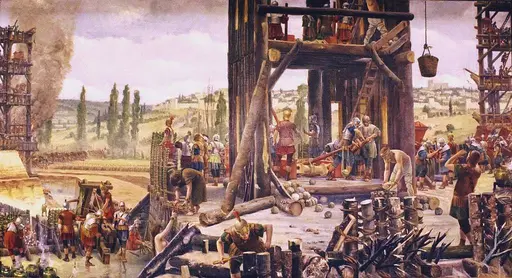
The Roman military machine functioned as an army of highly skilled engineers. The soldiers were as proficient with their digging tools, known as the dolabra, as they were with their swords. Caesar commanded his troops to construct a massive inner wall known as the circumvallation. This defensive line stretched for eleven miles entirely around the base of the hill.
The construction process was brutally efficient and physically exhausting. The legionaries dug a trench twenty feet deep with completely vertical sides near the base of the hill to stop sudden cavalry charges. Behind this initial ditch, they dug two more massive trenches fifteen feet wide and fifteen feet deep. They diverted a local river to fill the innermost trench with water.
Behind the trenches, the Romans built an earthen rampart topped with a heavy wooden palisade standing twelve feet high. They constructed massive wooden watchtowers every eighty feet along the entire eleven-mile perimeter. The engineers also seeded the ground in front of the walls with horrific booby traps. They buried wooden stakes tipped with iron hooks, known as stimuli, just below the surface of the earth. They dug deep pits lined with sharpened spikes, called lilia, and concealed them with light brush. These hidden traps broke the momentum of any Gallic charge before the attackers could even reach the walls.
The Contravallation: Defending the Besiegers
Vercingetorix managed to dispatch cavalry messengers through the Roman lines before the circumvallation was completely closed. He sent a desperate call for a massive relief force. Caesar knew a massive Gallic army would soon arrive to attack his vulnerable rear.
Caesar ordered his exhausted legions to build a second line of fortifications facing outward. This outer wall, known as the contravallation, stretched for thirteen miles. The Roman army was now trapped completely between their own two massive walls. They faced 80,000 starving warriors on the inside and a relief force of an estimated 250,000 Gauls on the outside.
The Siege of Alesia became a true test of physical endurance and psychological terror. Rations within the Roman camp dwindled. The situation inside Alesia grew catastrophic. Vercingetorix ordered the women, children, and elderly citizens of the local Mandubii tribe out of the fortress to save food for his fighting warriors. Caesar refused to let them pass the Roman lines. The civilians slowly starved to death in the narrow strip of land between the two armies.
The Final Battle and the Fall of Gaul
The massive Gallic relief force eventually arrived and launched a coordinated assault against the outer wall. Simultaneously, Vercingetorix led his warriors in a desperate breakout attempt against the inner wall. The Roman legions fought furiously in both directions for three consecutive days. The soldiers survived on minimal sleep and sheer discipline.
The turning point of the Siege of Alesia occurred on the third day. The Gallic relief force discovered a weak point in the Roman contravallation where the natural geography prevented the construction of a complete, unbroken wall. Thousands of Gallic warriors poured into the gap. The Roman line began to buckle under the immense pressure.
Caesar personally rode into the combat zone wearing his distinct red commander’s cloak. He rallied his terrified troops and committed his final cavalry reserves to strike the rear of the attacking Gallic column. The psychological impact of the Roman cavalry charge broke the morale of the relief force. The Gallic army routed and fled into the surrounding forests in complete panic.
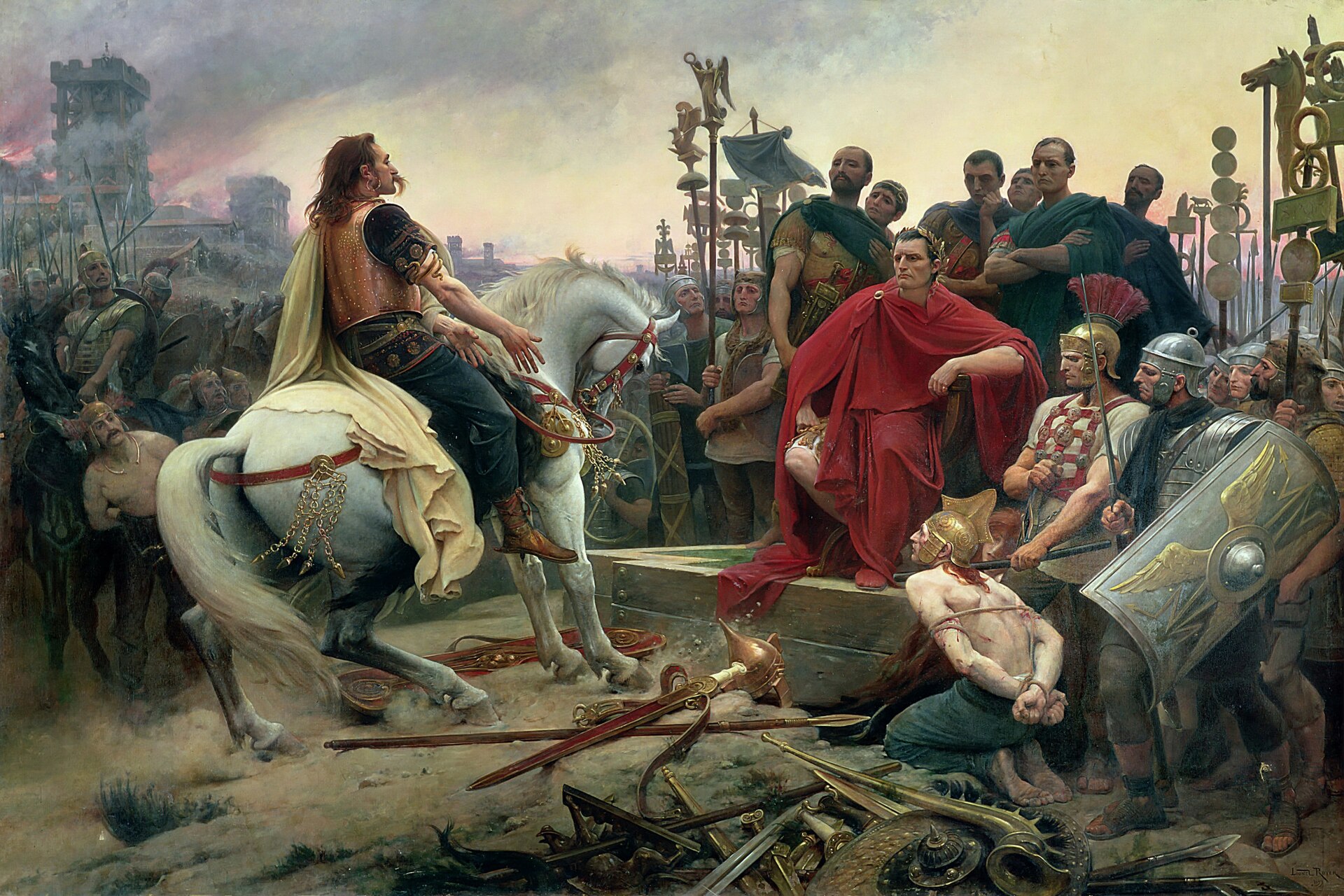
Recognizing that all hope was permanently lost, Vercingetorix rode out of Alesia the following day. He threw his weapons at the feet of Julius Caesar, surrendering himself and the entirety of Gaul. The Siege of Alesia ended with a total Roman victory.
The Economics of Victory and the Roman Domus
The consequences of this victory echoed directly into the heart of the republic. Caesar returned to the civitas with unimaginable wealth and military prestige. He captured tens of thousands of Gauls and sold them into slavery. This massive influx of human capital completely transformed the Roman economy.
The spoils of war allowed Caesar to pay off his massive political debts. He used his new wealth to buy immense political support in the forum. He funded lavish public games and handed out cash directly to the plebeians. The political factions aligned against him, led by Pompey Magnus, realized Caesar possessed the wealth and the veteran army required to seize control of the government. The victory at Alesia set the stage for the devastating civil war that eventually destroyed the Roman Republic.
Redefining Ancient Power in Venusia Magna
The political and military structures of antiquity were heavily guarded systems controlled exclusively by men. Venusia Magna features a vital, historically grounded lore exception regarding leadership and power within our community. Within our civitas, women possess the legal right to hold political office, govern the city, and direct the flow of power.
Female characters execute high-level political strategies, form devastating alliances, and shape the entire future of our society. This structural rule creates a deeply competitive, highly engaging political arena for all participants. Every roleplayer has the opportunity to rise to the highest levels of influence, manage city resources, and dictate the laws of the forum. You can use your accumulated wealth to secure a luxurious domus, hire private guards, and fund public spectacles to win the favor of the populace.
Authentic Roman Roleplay in Second Life
Venusia Magna provides a high-quality environment for adult roleplay within Second Life. We demand brutal honesty, high efficiency, and deep immersion in all of our systems. When you enter our city, you participate directly in a living, breathing political machine.
The architecture, the legal framework, and the daily cultural routines deliver historical realism. The future of your character depends entirely on your intelligence, your alliances, and your raw ambition. We offer the premier adult destination for those who demand a complex, realistic setting. You can plot your rise to power in the shadows, manipulate the voting blocs in the forum, or attempt to seize control of the entire civitas through military or economic dominance. Ready to craft your own Roman identity? Start with our Roman Name Generator.
About the Author and the Venusia Magna Vision
I am Jess X, recognized across our community as Junia. The X-Sisters brand was established in 2023. We set a completely new standard for community building and immersive venues in virtual worlds. Expanding upon that highly successful foundation, Venusia Magna was founded in late 2024.
We dedicate ourselves completely to deep research into classical history. We guarantee our venues deliver an authentic, highly engaging experience. Our leadership team focuses entirely on providing a stable, high-performance sim. Roleplayers can fully explore the complexities, the dangers, and the incredible status of ancient society here. We do not build standalone video games. We build lasting, deeply detailed communities inside of Second Life.
Claim Your Status
Are you ready to test your strategic brilliance and claim your political status? You must navigate the complex web of ancient politics, forge powerful alliances, and crush your rivals to survive. Join the premier adult Ancient Roman roleplay destination today. Experience the unmatched intensity of the forum and secure your legacy right now.
Visit Us To Begin Your Journey
Leave a Reply