The Rise and Fall
A Complete Timeline of the Roman Empire and the Foundation of Virtual Ancient Rome
The history of Rome spans over 1,200 years of continuous political, military, and cultural development. This makes it one of the most influential civilizations in human history. To fully appreciate our Second Life Roman Roleplay Sim and navigate its unique lore, you need a firm understanding of the authentic timeline. Historians divide the history of the Roman Empire into three distinct eras: the Kingdom, the Republic, and the Empire.
Phase I: The Roman Kingdom
753 to 509 BCE
The earliest period of Roman rule operated as a monarchy. A line of early kings founded the city on myth and slowly consolidated their rule. This era established the foundational social divisions and religious practices that would persist for a millennium. The Roman people held fiercely to the legends of this time. The stories anchored their identity and set a strong precedent for centralized, absolute power within the city walls.
Legendary Founding of Rome
According to ancient tradition, the twins Romulus and Remus found Rome on the Palatine Hill. Romulus kills his brother and establishes himself as the very first king. This founding myth immediately imbued Rome with a destiny linked to ambition, violence, and singular leadership. These exact themes frequently reappear in later political drama.
Etruscan Influence and Infrastructure
The city falls under the powerful influence of the sophisticated Etruscan kings from the north. This period saw a dramatic expansion of Roman infrastructure. They drained the Forum swamp and constructed the Cloaca Maxima, Rome’s great sewer. This major investment allowed Rome to grow from a small settlement into a major urban center.
Overthrow of the Monarchy
The people exile Lucius Tarquinius Superbus, the final king, following a massive uprising. The subsequent popular revolt against the institution of kingship results in the creation of the Republic. This event permanently instilled a deep cultural aversion to single-person rule. Julius Caesar would later exploit this exact sentiment, and Octavian would subtly dismantle it.
Phase II: The Roman Republic
509 to 27 BCE
Elected magistrates, known as Consuls, and the powerful Senate defined the Republic. Massive territorial expansion and intense internal civil strife characterized this period. This complex system balanced the power of the aristocratic Patricians and the common Plebeians. The Republic achieved incredible conquest. Eventually, the internal mechanisms succumbed to the pressures of immense wealth, military power, and ambitious generals.
The Law of the Twelve Tables
Rome publicly displayed its first foundational codified law in the Forum. Establishing a firm foundation of public and private rights, this law represented a major concession to the Plebeians. It remains a crucial part of Roman legal tradition and represents the earliest attempt to protect the common citizen from arbitrary actions by the ruling elite.
The Punic Wars
Rome fought a series of three brutal conflicts against the great Phoenician city of Carthage. Rome’s ultimate victory in the Third Punic War established it as the supreme naval and military power of the Mediterranean. This expansion introduced unprecedented wealth and a massive influx of slaves. This influx destabilized the Roman economy and severely widened the gap between the rich and the poor.
The Gracchi Brothers
The populist Tribunes Tiberius and Gaius Gracchus attempted to reform land distribution and help the poor. Their actions triggered severe political violence. Their deaths marked the beginning of a bloody century of civil disorder. Factions began using violence as a regular political tool, setting the stage for the downfall of the Republic.
Caesar Crosses the Rubicon
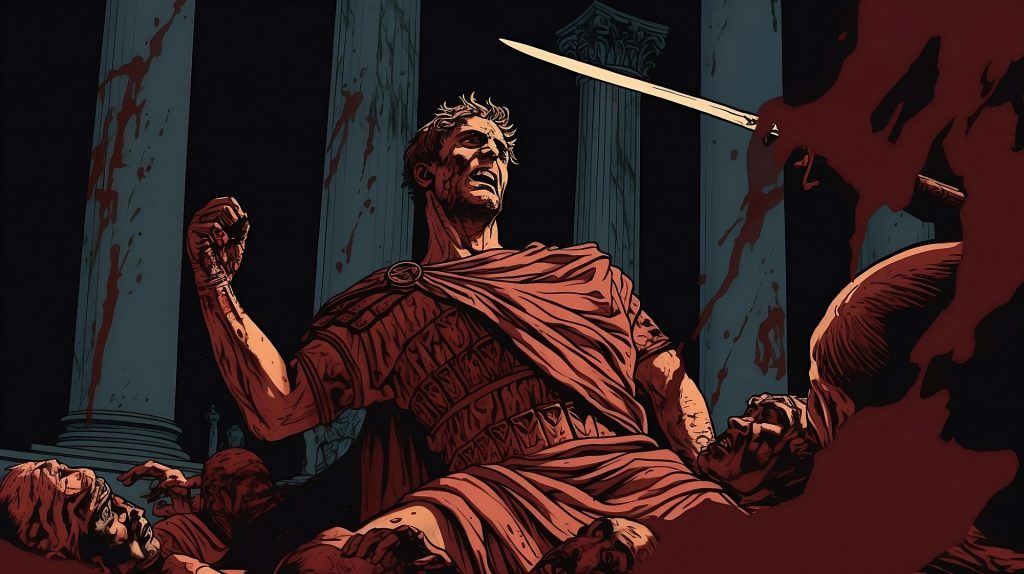
Julius Caesar defies the Senate’s decree to disband his army and begins a devastating civil war. By bringing his legions out of Gaul and across the legal boundary of the Rubicon River, Caesar made the fateful decision to seize control of Rome. This confirmed that the loyalty of the army now superseded the authority of the law.
Battle of Actium
Octavian defeats the combined forces of Mark Antony and Cleopatra. This naval victory left Octavian as the unchallenged master of Rome. He effectively ended the final civil war and laid the groundwork for his transition to Emperor.
Phase III: The Roman Empire
27 BCE to 476 CE
Augustus initiated this final era, characterized by the Pax Romana, vast territorial expansion, and the institutionalization of the Emperor as a divine figure. It represented a highly successful consolidation of power. It also carried the seeds of its own destruction through issues of succession, severe economic imbalance, and continuous external pressure.
The Reign of Augustus and the Pax Romana
Octavian skillfully reorganized the state. He maintained the visual facade of the Republic while holding all true military and political power. The Senate granted him the title Augustus, making him the first Roman Emperor. He inaugurated the Pax Romana, marking two centuries of relative peace, stability, and cultural flowering across the Mediterranean.
The Great Fire of Rome
A massive fire devastated Rome. Emperor Nero blamed the nascent Christian community and initiated the first major wave of state-sponsored persecution. This historical event highlights the growing instability and the absolute, often erratic, power held by the emperors.
The Empire Reaches its Zenith
Under the great military commander Emperor Trajan, the Roman Empire reached its absolute largest territorial extent. The borders spanned three continents and encompassed nearly 5 million square kilometers. Trajan’s massive public works and military success epitomize the absolute peak of Imperial power.
Constitutio Antoniniana
Emperor Caracalla issues an edict granting formal Roman citizenship to virtually all free inhabitants of the Empire. Emperor Caracalla intended to raise tax revenue and strengthen loyalty. This act dramatically changed the identity of the citizens and diluted the traditional value of Roman birthright.
Permanent Division of the Empire
Upon the death of Theodosius I, the Empire permanently splits into the Western Roman Empire and the Eastern Roman Empire. This division cemented the long-term divergence of the two halves. The political and cultural split made the Western half significantly more vulnerable to external pressures.
Fall of the Western Roman Empire
In the year 476 CE, the Germanic warlord Odoacer deposed the last Western Roman Emperor, Romulus Augustulus. The removal of the Emperor in the West marks the collapse of central Roman authority and signals the beginning of the Middle Ages in Western Europe.
Bring History to Life in Venusia Magna
Understanding the transition from the chaotic late Republic to the highly structured power of the Empire provides the perfect foundation for high-quality Second Life Roman Roleplay.
Our dedicated community at Venusia Magna exists in a timeline that directly mirrors the intense political tension of the late Imperial period. We use authentic historical events to build a magnificent, immersive virtual world.
The Dominae Consilium
This matriarchal government mirrors the absolute power of the Emperors. They replace the unreliable Senate with a fiercely competitive, centralized authority that dictates the flow of daily life.
The Social Hierarchy
The dramatic economic stratification seen after the Punic Wars reflects directly in our community. You can review the Citizenship Census to see the vast difference between a wealthy Patrician and a vulnerable slave. Players taking on servitude must study the Slave Training Guide to survive.
The Law of the Land
Our Lex Aurea formalizes the laws of the Empire. Much like the great Roman legal codes, it provides a stable, unforgiving framework for all player interactions. You must read the City Charter and abide by the Sim Rules to secure your place in the city.
By engaging in Roman Roleplay here, you participate directly in the epic struggle between law and ambition that defined this magnificent civilization.
Submit Your Application Teleport to the Sim